Operating principle
Triple eccentric butterfly valves
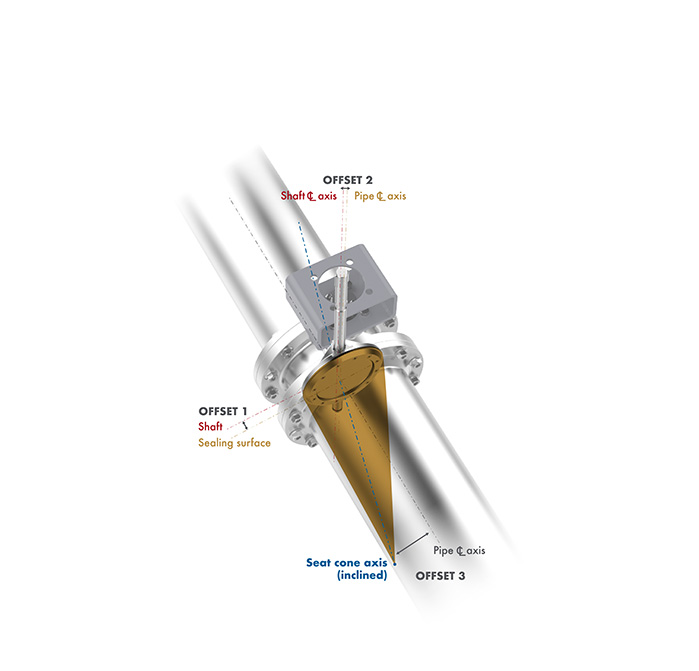
Offset 1
The valve shaft is offset from the seating surface to maintain continuous contact geometry between the seal ring and the seat.
Offset 2
The shaft is positioned eccentrically relative to the pipe centerline, allowing the seal ring to shift from the seat during rotation.
Offset 3
The seat is manufactured with a conical geometry, with the cone axis inclined relative to the pipe centerline. This design prevents any rubbing between the sealing surfaces, ensuring friction-free operation.
Advantages
Compared to gate, globe, or ball valves in larger diameters, triple eccentric butterfly valves offer a more compact and lightweight solution, reducing installation space, structural support requirements, and overall costs.
Triple eccentric butterfly valves are ideal for medium- to high-pressure systems and extreme temperature applications where tight shut-off, fire safety, resistance to thermal cycling, and long-term durability are essential. They are commonly actuated with gearboxes or by pneumatic, electric, or hydraulic actuators and can be designed to provide uni-directional or bi-directional sealing, depending on application requirements.
Their combination of compact design, zero-leakage capability and suitability for demanding services makes them a preferred choice in industries such as oil and gas, power generation, chemical processing, and cryogenic applications.